

Omise AI
AI-powered efficiency
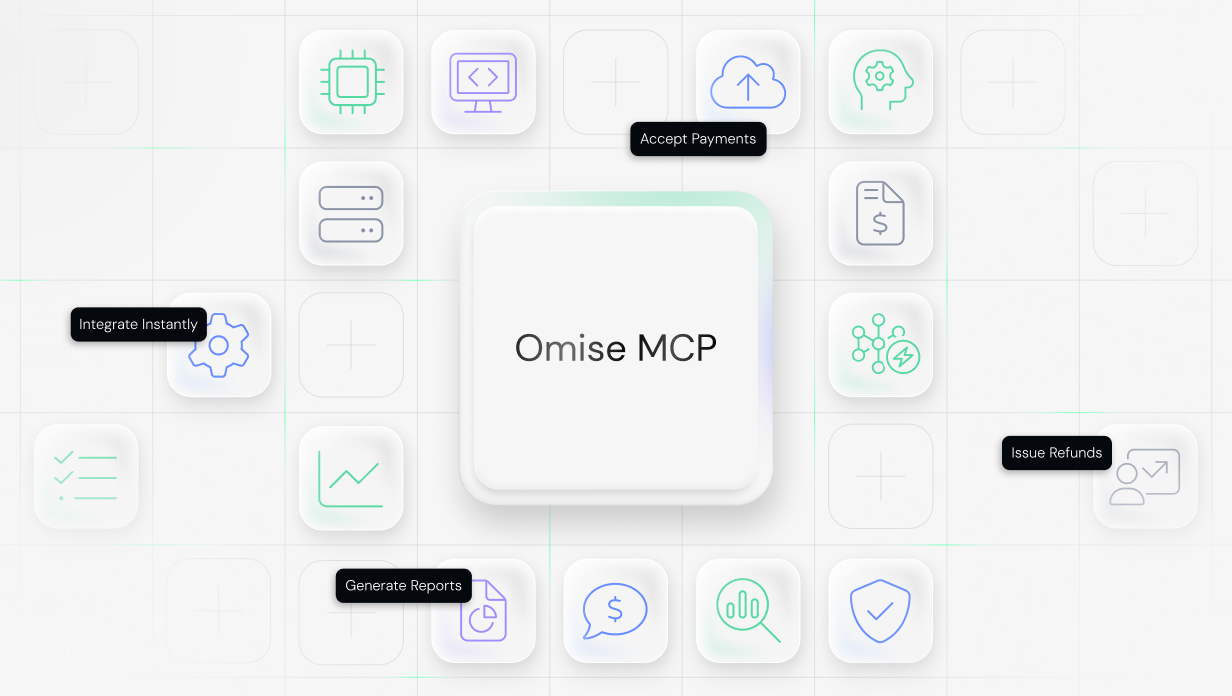
In November 2025, Omise released Omise MCP, a next-generation payment infrastructure that seamlessly integrates payment processing with AI agents. This innovation enables AI and payment systems to work together intelligently, redefining how merchants and customers experience payments.
Many have heard the buzz about MCP by now, but not everyone fully understands what it is or why it’s generating so much attention. In this article, we’ll explore what MCP means, how it works, why it matters, and how it’s transforming industries.
MCP, short for Model Context Protocol, is an open standard developed by Anthropic, the company behind Claude AI. It was designed to make it easier for AI systems to connect with data sources, tools, and external services.
While today’s AI models are powerful, they often operate within data silos, isolated systems that limit their ability to interact with the broader digital ecosystem. Connecting AI to other tools traditionally required writing custom integration code for each service’s API, a time-consuming and maintenance-heavy process.
MCP changes that.
Think of MCP as “the AI equivalent of USB-C.” Just as USB-C provides a universal connector for all kinds of devices, MCP offers a unified way for AI agents to communicate with any compatible data source or tool. This eliminates the need for one-off integrations and makes it dramatically easier for AI systems to collaborate and perform real-world tasks.
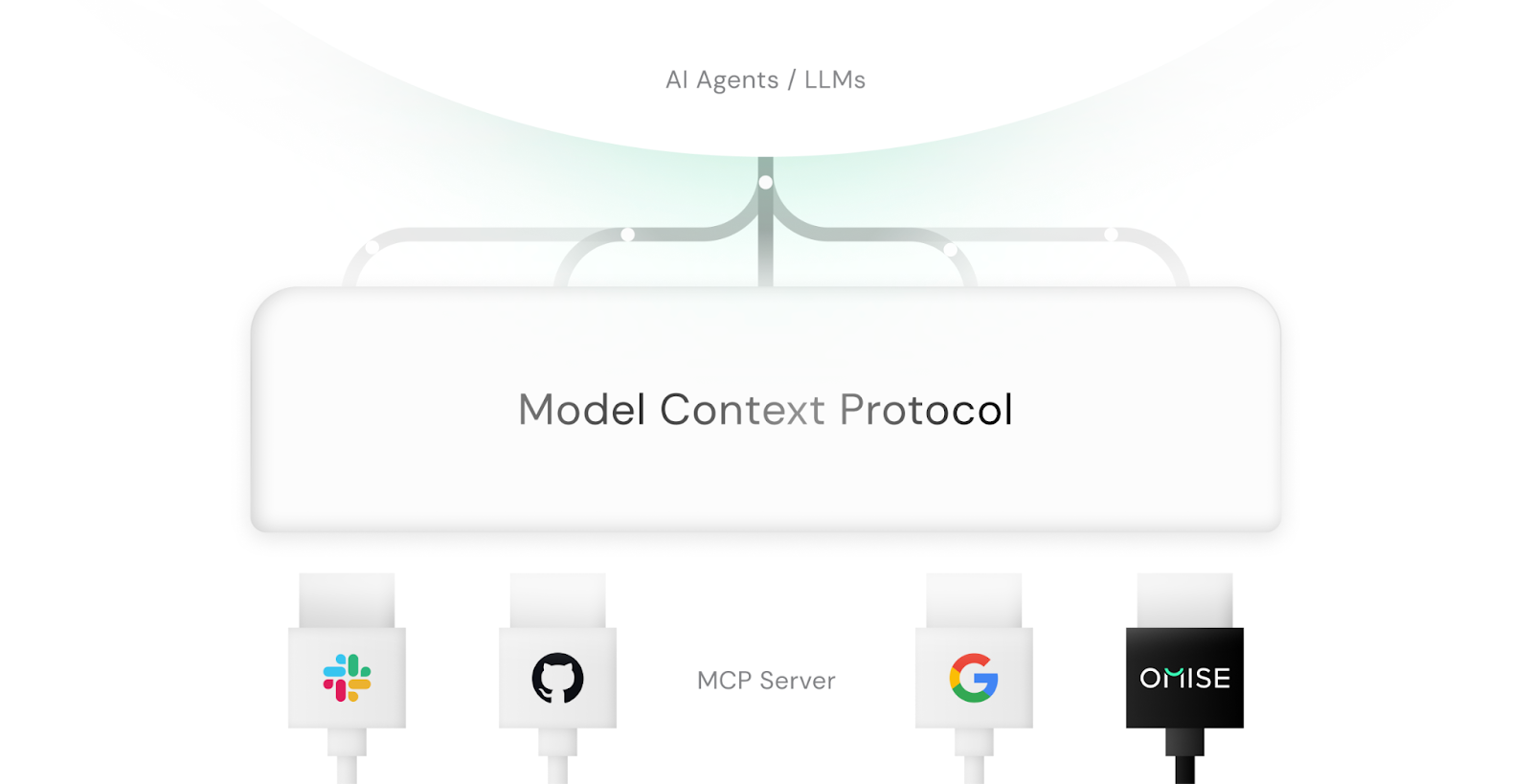
Traditional API Integration vs. MCP
Traditionally, connecting an AI model to multiple tools required custom integrations for many separate APIs, each with its own codebase, documentation, authentication method, error handling, and maintenance process.
To put it simply, the traditional approach was like needing a different plug for every outlet.
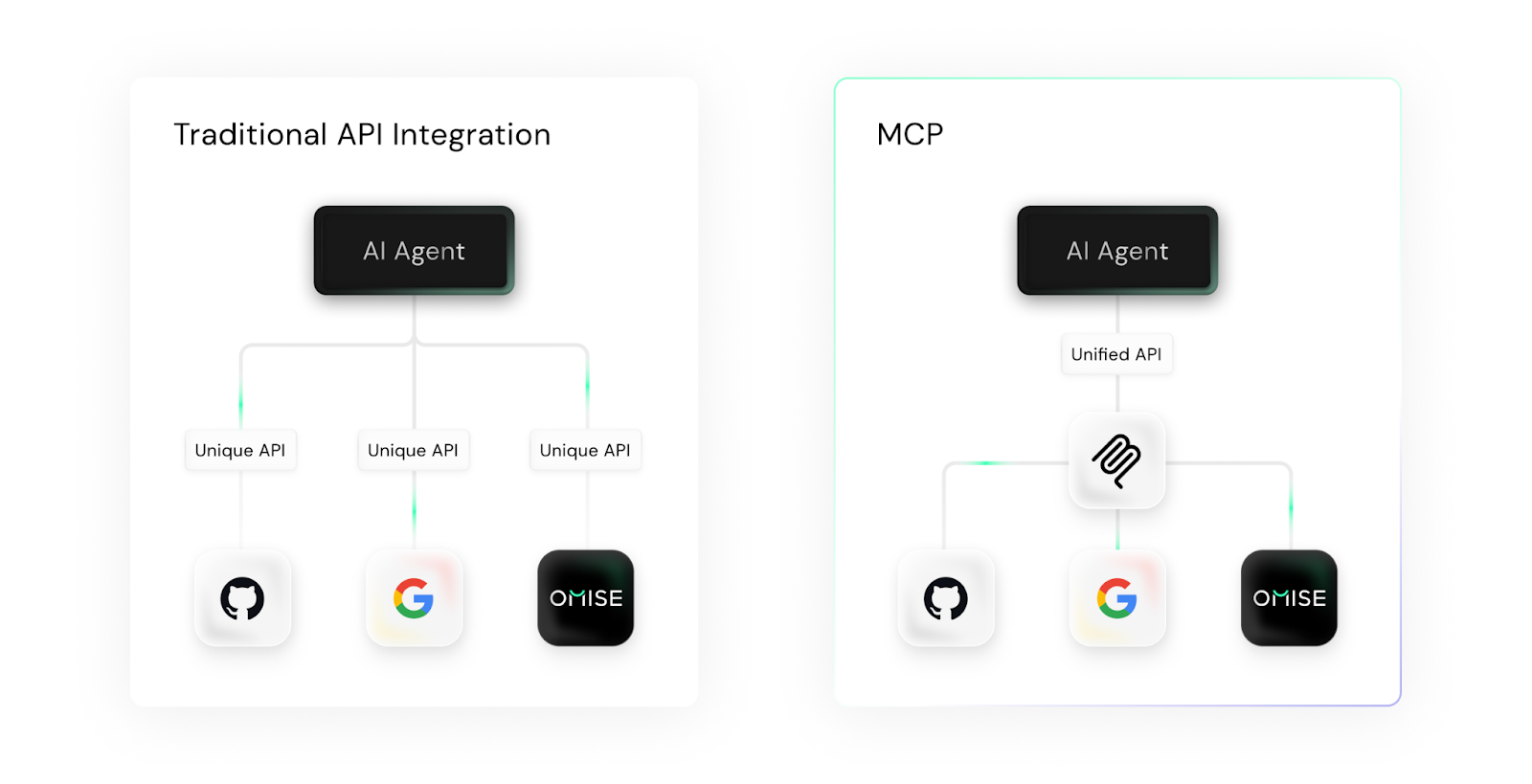
With MCP, all those separate mechanisms are replaced by a single open-source protocol that acts as a standardized connector, allowing AI systems to interact with external services, tools, and data sources seamlessly and securely. Hence the name “USB-C for AI.”
Beyond enabling AI to access and use the right information at the right time, MCP also supports two-way communication. This means an AI agent connected via MCP can not only retrieve data from external systems but also invoke specific actions, such as updating records, sending messages, or triggering workflows, depending on how each integration is configured.
AI has evolved from simply generating responses to operating as autonomous agents: systems that can analyze data, make decisions, and execute tasks through connected tools. This new level of connected intelligence is accelerating change at an unprecedented pace. Cloud-native deployments and AI-as-a-Service models are becoming more accessible and powerful, while edge AI enables faster, real-time decision-making at the device level. The conversational and analytical capabilities of AI systems have advanced significantly. And this progress is made possible by standardized protocols like MCP.
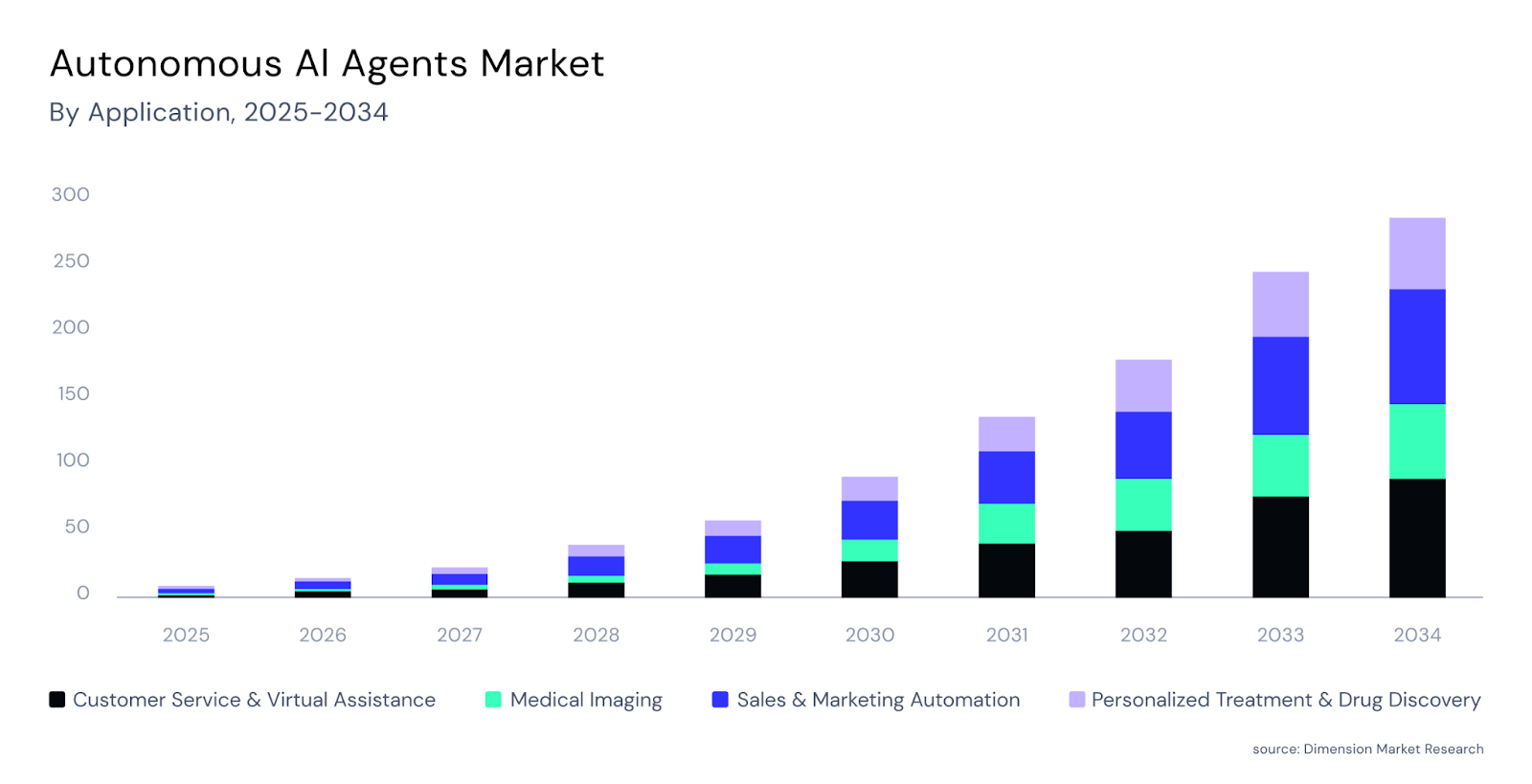
Now that a universal standard is emerging, the potential of connected AI is becoming clearer across industries. This shift is driving massive investment in AI agents capable of real-world action. According to market research, the global autonomous AI agents market—valued at around USD 9.9 billion in 2025—is projected to grow rapidly, reaching approximately USD 253 billion by 2034.
For payments, AI agents will transform the industry at every layer, from how developers build software and infrastructure, to how businesses manage transactions, to how consumers interact with money.
With MCP improving interoperability between AI and external systems, payments can become more secure and seamless, operational cost and time can be greatly reduced, and customer experiences will be measurably better. Let’s look at a few ways these capabilities could reshape how payments actually work in practice.
Even though payment technology is now so advanced, there are still many manual processes in the industry. For example, the KYC process remains one of the biggest bottlenecks in fintech. But imagine if several AI agents worked together — an Identity Agent to verify customer identity documents, a Compliance Agent to check businesses against regulatory requirements, and a Risk Agent to analyze business risk factors. With this collaboration, onboarding could shrink from days to minutes.
And beyond KYC, AI agents can automate other repetitive operational tasks such as reconciliation and reporting. The result? Faster settlements, lower costs, and fewer human errors. (Learn more about Omise’s vision for Autonomous Onboarding here.)
AI agents can continuously monitor transaction streams and coordinate across gateways, risk engines, and acquiring partners in real time. For example, if an agent detects an unusual spike in declines, it can correlate failure patterns, identify a regional acquirer outage, and autonomously reroute traffic to an alternate partner while alerting finance, no manual coordination or brittle custom integration required. This reduces false positives, shortens incident resolution windows, and preserves revenue during partial outages.
AI agents embedded in consumer apps or wallets will understand user habits, choosing the best payment method based on timing, fees, or loyalty benefits. One example already taking shape is “Agentic Commerce,” where customers can simply tell an AI agent what they want, and it does the rest: browsing, comparing options, and completing the checkout on their behalf. It’s a powerful antidote to cart abandonment on websites with millions of items.
Payments are a regulated, high-trust environment, but these futures will be possible because MCP provides a standardized and reliable way for AI to connect with systems safely. That’s why MCP matters, not only in payments, but across every part of our digital lives.
At Omise, we’re working toward a future where financial technology is accessible to everyone and simple to integrate, empowering businesses to achieve their goals. We’re excited to introduce Omise MCP, a powerful new solution designed to support seamless integration and enable merchants to perform a wide range of advanced payment operations.
What can Omise MCP server do for you?
The Omise MCP Server provides over 60 dedicated tools that cover the full scope of the Omise API. Here are some key areas:
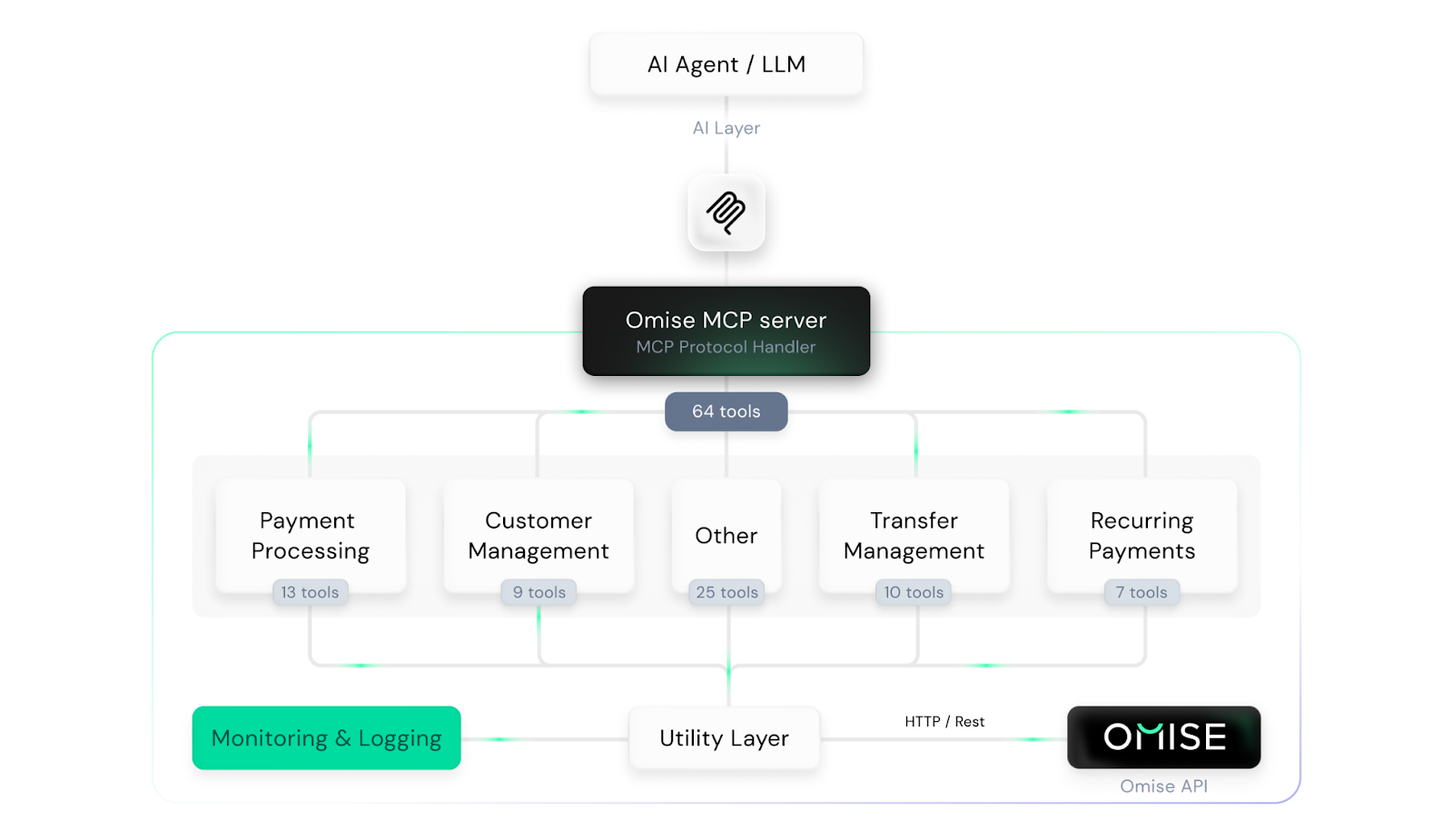
With Omise MCP, merchants can enable their AI agents, such as customer support chatbots or internal finance assistants, to execute complex, multi-step financial actions securely and automatically.
For instance, merchants can let their AI agents accept payment seamlessly across multiple payment methods. When a customer is ready to make a purchase, the AI agent can process transactions, whether it’s through credit or debit cards, bank transfers, e-wallets, or QR code payments. The system securely collects and tokenizes the customer’s payment information, creates the charge, and confirms the transaction in real time. Once the payment is successful, the agent can instantly issue a receipt, update the order status, and notify the customer.
Similarly, an AI agent can process a customer refund simply by typing a command such as, “I need a refund for order #XYZ.”
The agent securely looks up the transaction details using the order number, verifies the customer’s eligibility against the business rules, and then automatically calls the refund API with the correct charge ID and refund amount. Once the refund success webhook is received, the agent sends a final confirmation message to the customer to complete the process.
These are just a few examples of what’s possible. With Omise MCP, merchants can go even further — from enabling inventory management AIs to pay suppliers automatically, to dynamically adjusting recurring payments based on business conditions, or even building entirely new business models.

Enterprise-Grade Security and Reliability
Omise MCP is designed for mission-critical, high-volume financial operations and adheres to enterprise-grade reliability standards. It is built entirely in TypeScript, ensuring strong type safety and early bug detection, and maintains over 95% test coverage to guarantee system stability across updates.
The platform is continuously monitored 24/7 using Docker for consistent, predictable deployment across environments, Prometheus for real-time performance metric collection, Grafana for clear and actionable performance visualization, and Redis to deliver exceptional speed, scalability, and efficient data handling.
And that’s not all. We’re going beyond by introducing the A2A protocol, which allows AI agents to communicate directly with one another. When combined with Omise MCP, this innovation unlocks the next level of automation and intelligence for your business.
1. AI Customer Support
Scenario: An e-commerce customer contacts support and says, “I didn’t receive my product, so I’d like a refund.”
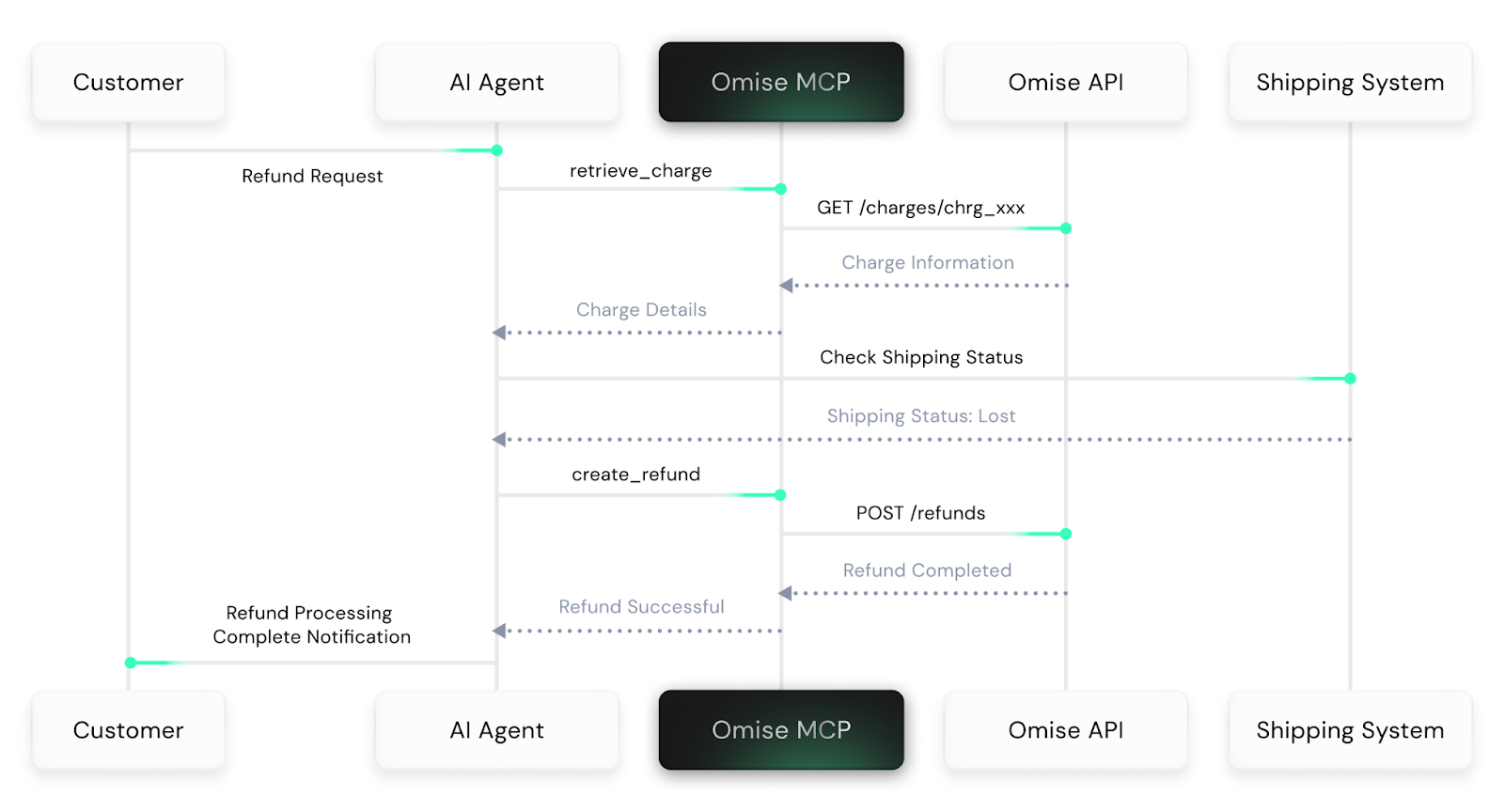
// AI agent processing flow
// 1. Verify order information
const charge = await mcp.callTool('retrieve_charge', {
  charge_id: 'chrg_xxx'
});

// 2. Check shipping status (integrate with other MCP servers)
const shipping = await checkShippingStatus(order.tracking_number);

// 3. If conditions are met, automatically refund
if (shipping.status === 'lost') {
  const refund = await mcp.callTool('create_refund', {
    charge: 'chrg_xxx',
    amount: charge.amount,
    reason: 'Order not delivered'
  });
  // 4. Notify customer
}
Impact: Reduced customer wait time, lower support costs, improved customer satisfaction
2. Subscription Management AI
Scenario: A SaaS company wants to automatically optimize customer subscription plans based on how much they actually use the service each month.

// Monthly usage analysis and optimization
const customer = await mcp.callTool('retrieve_customer', {
  customer_id: 'cust_xxx'
});

// Calculate optimal plan from usage data
const optimalPlan = await analyzeUsagePatterns(customer);

// Update schedule
await mcp.callTool('update_schedule', {
  schedule_id: customer.subscription_schedule,
  charge: {
    amount: optimalPlan.price,
    description: `${optimalPlan.name} - Optimized for your usage`
  }
});
Impact: Revenue optimization, improved customer satisfaction, reduced churn rate
3. Automated Marketplace Payments
Scenario: A marketplace platform wants sellers to receive payments automatically once a sale is confirmed.
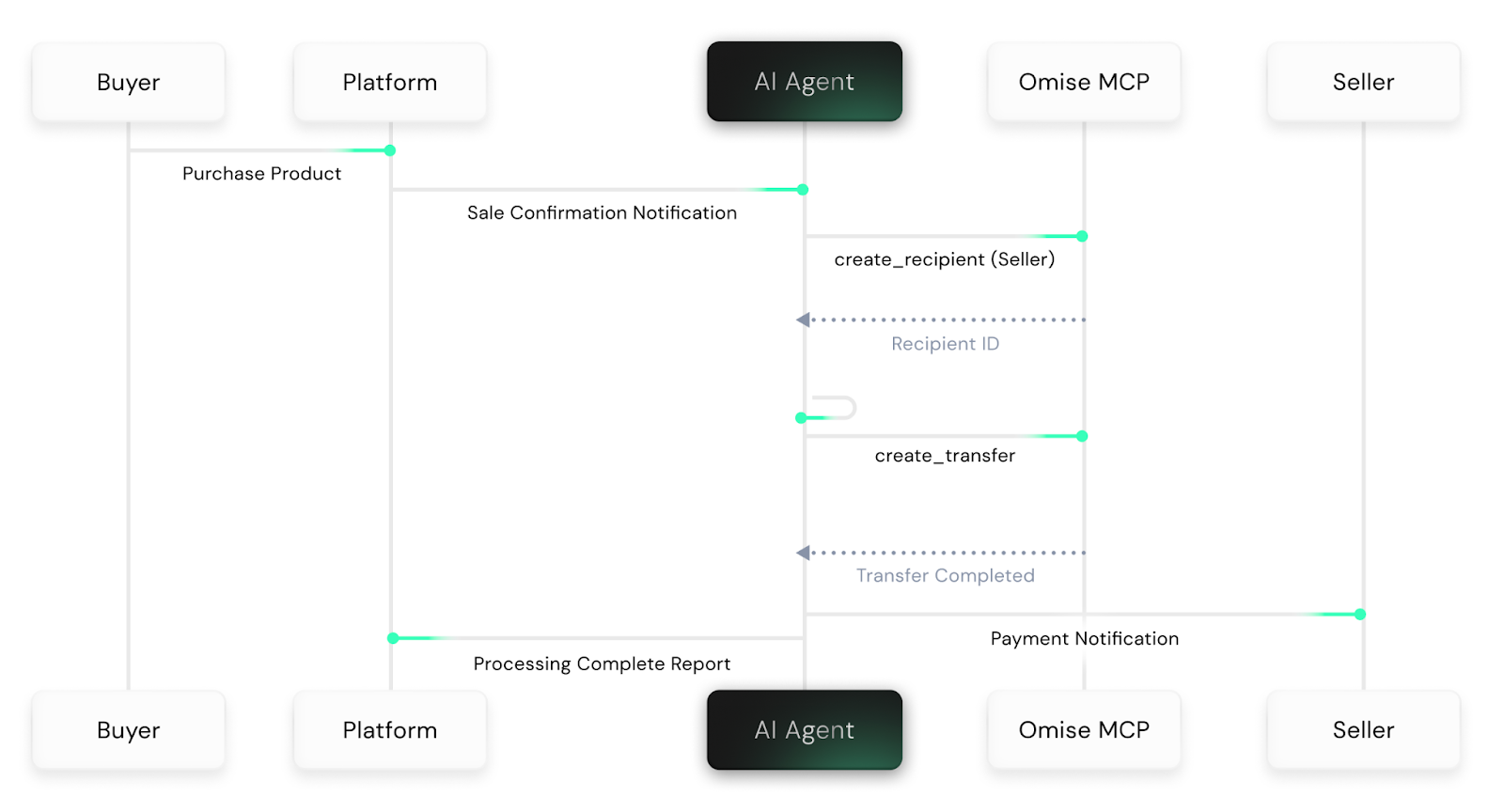
// Automatic processing after sale confirmation
// 1. Create/retrieve recipient information
const recipient = await mcp.callTool('create_recipient', {
  name: seller.name,
  email: seller.email,
  type: 'individual',
  bank_account: seller.bank_info
});

// 2. Transfer amount minus fees
const transfer = await mcp.callTool('create_transfer', {
  amount: saleAmount - platformFee,
  recipient: recipient.id
});

// 3. Notify transfer completion
Impact: Automated payment processing, reduced operational costs, improved seller experience
4. Fraud Detection and Automated Response
Scenario: A financial monitoring AI wants to detect and respond to suspicious payment activity in real time.

// Real-time monitoring
const events = await mcp.callTool('list_events', {
  type: 'charge.create',
  limit: 100
});

// AI fraud pattern detection
const suspiciousCharges = await detectFraud(events);

// Automatically hold suspicious transactions
for (const charge of suspiciousCharges) {
  await mcp.callTool('update_charge', {
    charge_id: charge.id,
    metadata: { fraud_check: 'pending' }
  });
  // Notify security team
}
Impact: Early fraud detection, loss minimization, enhanced security
5. Multi-Agent Autonomous Onboarding
Scenario : Multiple AI agents collaborate to fully automate KYC processing
// A2A Protocol in Action
const identityResult = await identityAgent.verify(documents);

const complianceCheck = await complianceAgent.assess({
identity: identityResult,
businessType: merchant.type
});

const riskScore = await riskAgent.analyze({
compliance: complianceCheck,
transactionHistory: merchant.history
});

// Three agents collaborate for final decision
if (riskScore.approved) {
await omiseMCP.activateMerchant(merchant.id);
}
Impact:
- Onboarding time: 2-3 days → 15 minutes (99.5% reduction)
- Manual review required: 100% → 5% edge cases only
- Processing cost: $45/merchant → $0.80/merchant
Omise MCP marks an exciting milestone, empowering developers to build smarter integrations and enabling merchants to unlock new levels of automation, scalability, and growth.
Read our documentation here to get started with Omise MCP, and stay tuned for more updates as we continue shaping the future of intelligent payments together.


