

Omise AI
AI-powered efficiency
In executive boardrooms nowadays, the tension is intense. On one side, boards and investors demand a bold, transformative AI strategy to secure future competitiveness. On the other hand, technical teams are overwhelmed by disconnected proofs-of-concept, vendor pitches, and experimental projects that lack a clear path to production.
While the mandate to move fast is universal, actual progress is rare. Most organizations find themselves caught in a cycle of high activity with low impact.
The Enterprise AI Paradox: Industry research reveals that while nearly 80%–90% of enterprises report actively experimenting with AI, fewer than 6% capture repeatable, bottom-line financial impact. Somewhere between the executive pitch deck and daily operations, over 80% of initiatives get stuck in "Pilot limbo."
We tend to treat AI like a fancy software utility to slap onto existing habits, rather than what it actually is, an engine for redesigning how work gets done. If you're sipping your coffee today thinking about how to move your team forward, the goal isn't to buy a better model. It's to find the right entry point.
The most common trap is starting with the question: "Where can we use AI?" That question almost always leads to novelty projects like writing corporate poetry or generating internal newsletter images.
Instead, look for operational friction. Ask yourself: "Where do our smartest people waste the most cognitive energy acting as human middleware?"

The ideal entry point is rarely a broad, company-wide initiative. It lives in processes that hit three specific sweet spots:
When an enterprise AI project stalls, leaders usually blame the technology. They assume the model hallucinated, the latency was too high, or the context window was too small. But in practice, successful implementations follow Boston Consulting Group's stark 10–20–70 rule:
If 90% of your leadership conversations are focused on evaluating AI vendors or picking models, you are over-indexing on the smallest part of the equation. An AI tool might summarize a 50-page document in four seconds, but if that summary sits unread in an inbox because the underlying workflow still relies on manual data re-keying, your return on investment remains zero. Technology doesn't generate value; orchestration does.

When you look at companies that have successfully moved past pilot limbo, they didn't try to reinvent their entire business overnight. They picked focused, high-friction operational workflows and re-engineered them:
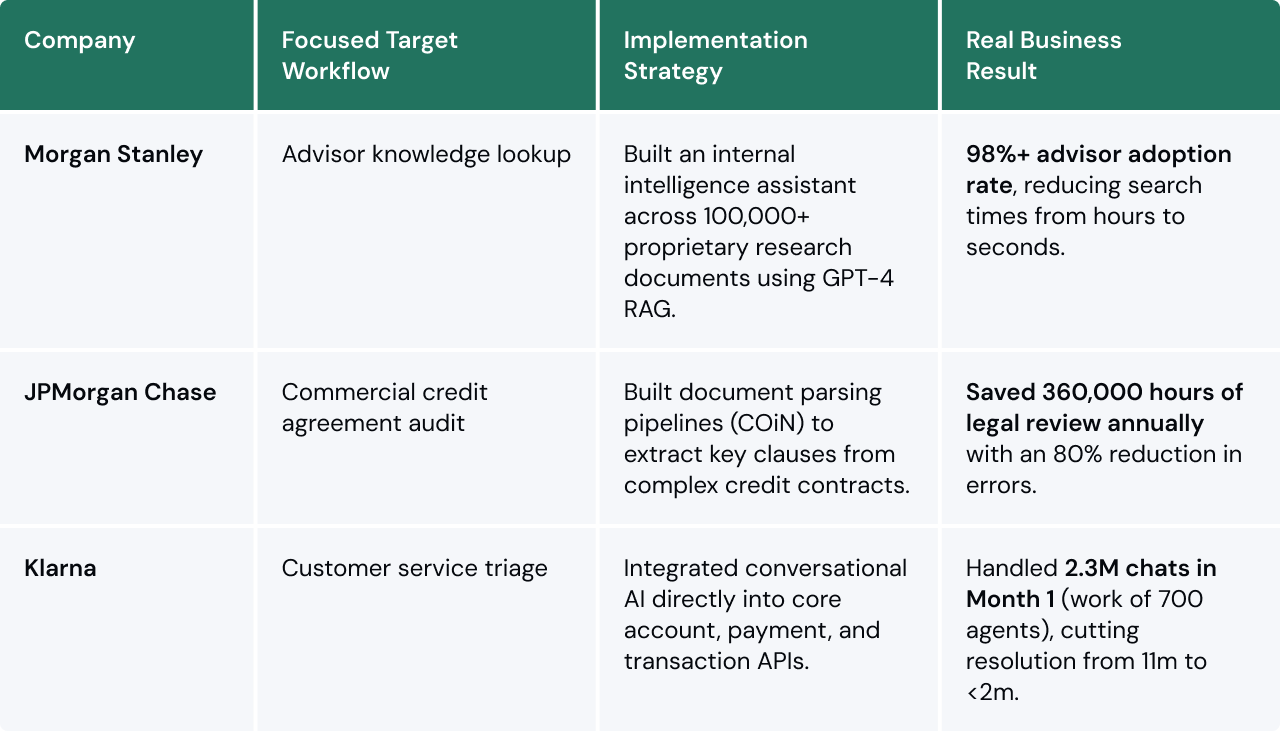
Key Field Observation: None of these companies tried to "replace human judgment." Morgan Stanley kept wealth managers at the center of client advice, JPMorgan focused on legal contract extraction, and Klarna tied AI directly to transaction databases. They succeeded because they targeted integrated business workflows rather than generic chat boxes.
To build momentum, your first AI project must be intentionally narrow. Broad charters like "AI for Customer Service" inevitably stall out. Instead, shrink the scope until it is broad enough to matter, but narrow enough to ship in 60 to 90 days.
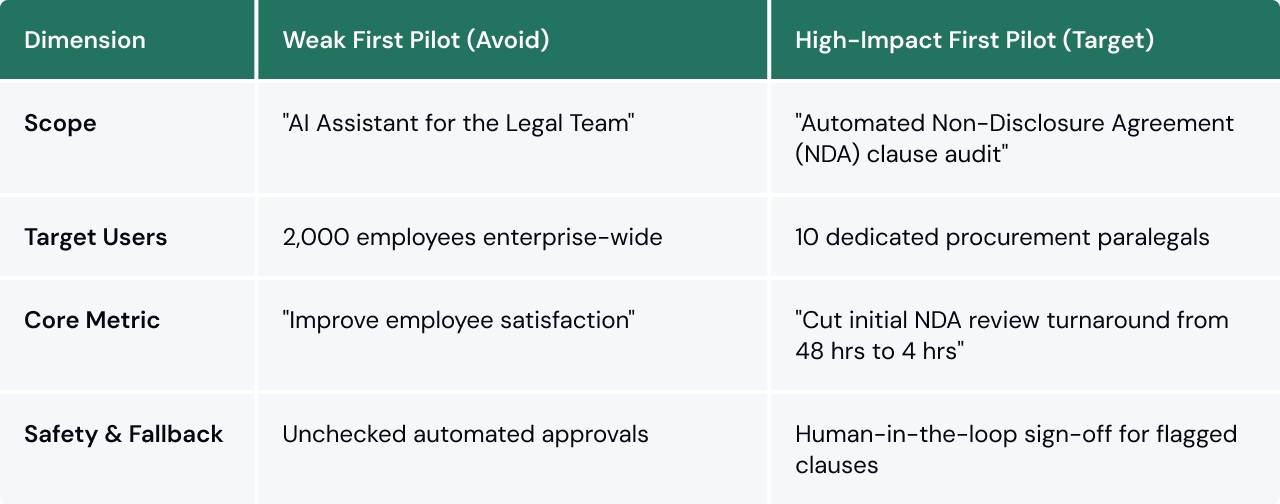
Narrowing the scope gives your team a clear sandbox to measure real time saved, tune accuracy, and prove value without betting the company.
The ultimate factor that dictates whether an AI project succeeds isn't the code, it's human trust. If employees feel that an AI system is being built to eliminate their jobs, they will naturally resist using it. Leadership must explicitly position AI as a tool that removes tedious "busywork" so team members can focus on high-value, strategic efforts.
Equally important: every project needs a named business owner, a VP of Operations or Head of Claims who owns the P&L and daily operations rather than just an R&D or IT sponsor. When frontline teams see business leaders actively using and supporting the tool, adoption follows.

A successful first pilot does something far more important than saving hours on a single task, it builds institutional muscle. It forces your technical, legal, and operational teams to figure out security, API integration, and change management for the first time. The second deployment will take half the time because the organizational pathways are already cleared.
The winners of the next decade won't be the organizations with the biggest AI budgets or the flashiest demos. They will be the teams that take a pragmatic, human-centered approach to workflow design: choosing one high-friction operational bottleneck, taking it apart, and building a cleaner, smarter way to work.
If you are ready to bridge the gap between vision and reality, we invite you to join Omise Pro at our upcoming seminar. This session moves beyond strategic principles to live execution, offering an inside look at how to drive true enterprise value with AI.
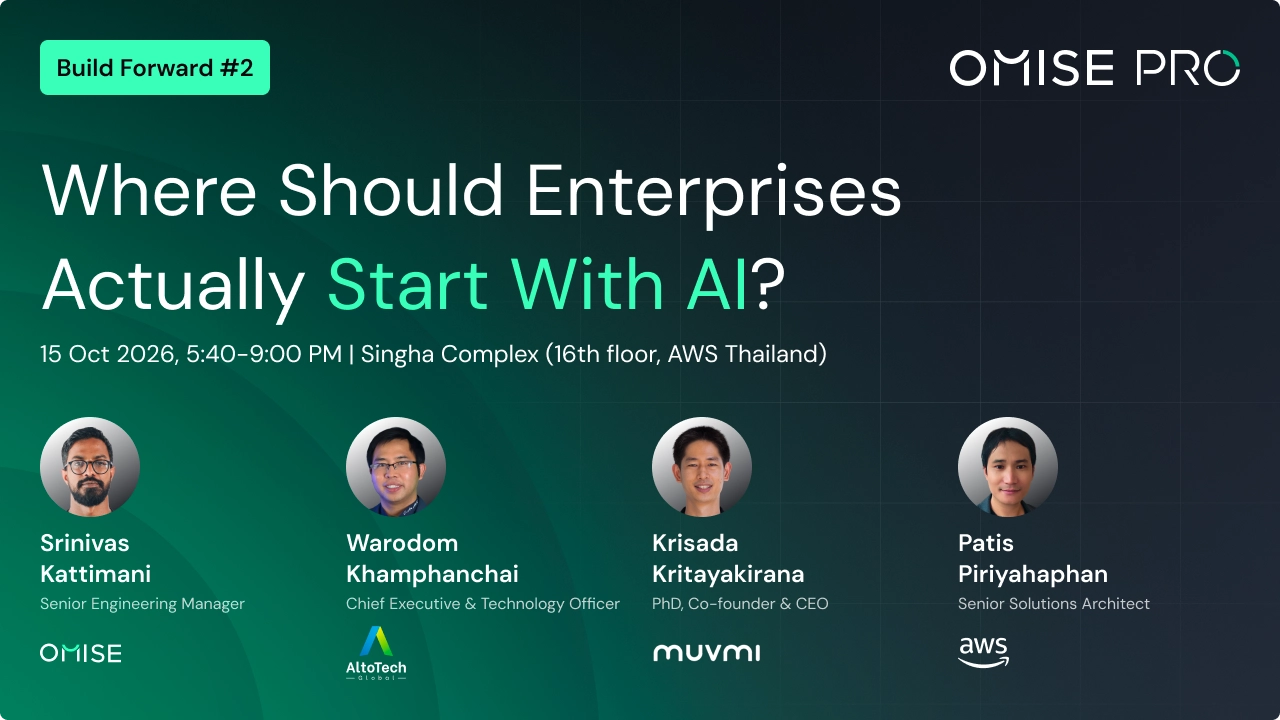
Our team will cover essential pillars for success, including how to identify business problems worth solving, what practical "AI readiness" looks like for your infrastructure, and how to select a focused, measurable first pilot.
We will also dive deep into the human side of technology, exploring how leadership and employee adoption influence long-term success and how early, successful experiments create the necessary institutional momentum for broader organizational transformation.
Reserve your spot here: https://luma.com/zf6b5vzx


