

Omise AI
AI-powered efficiency

AI can create an impressive demo in a matter of days.
But what happens when that demo meets real users, real data, and a real operating budget?
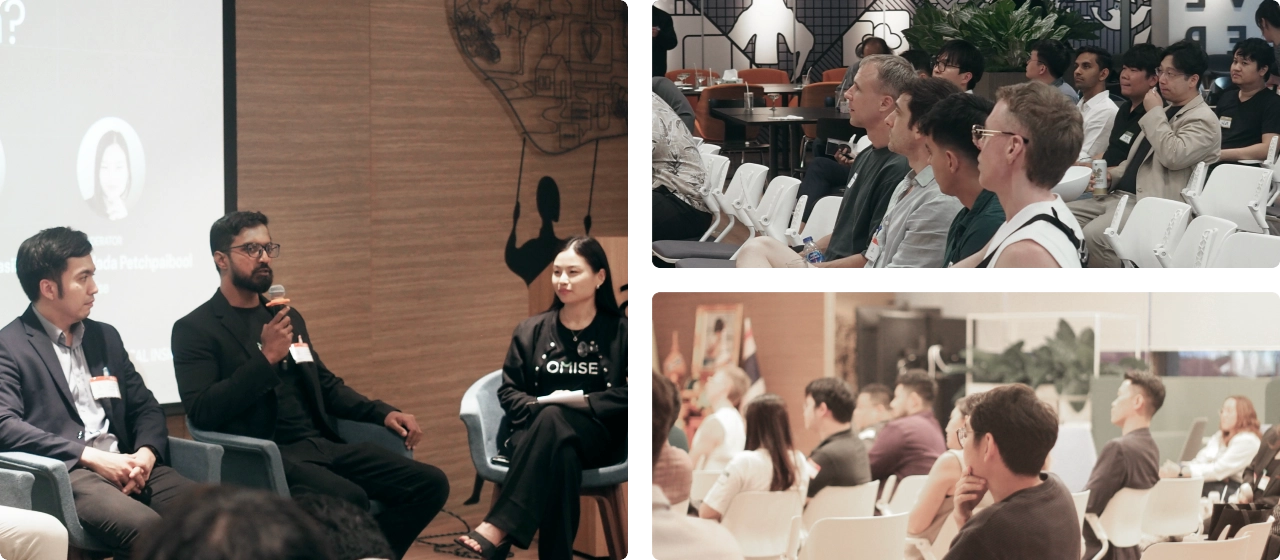
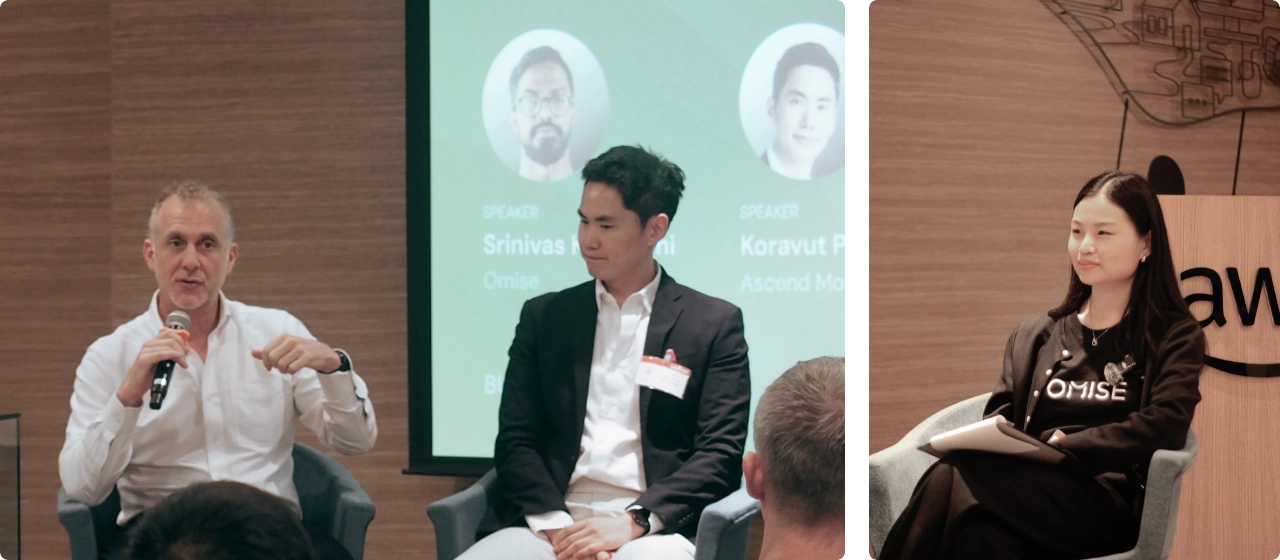
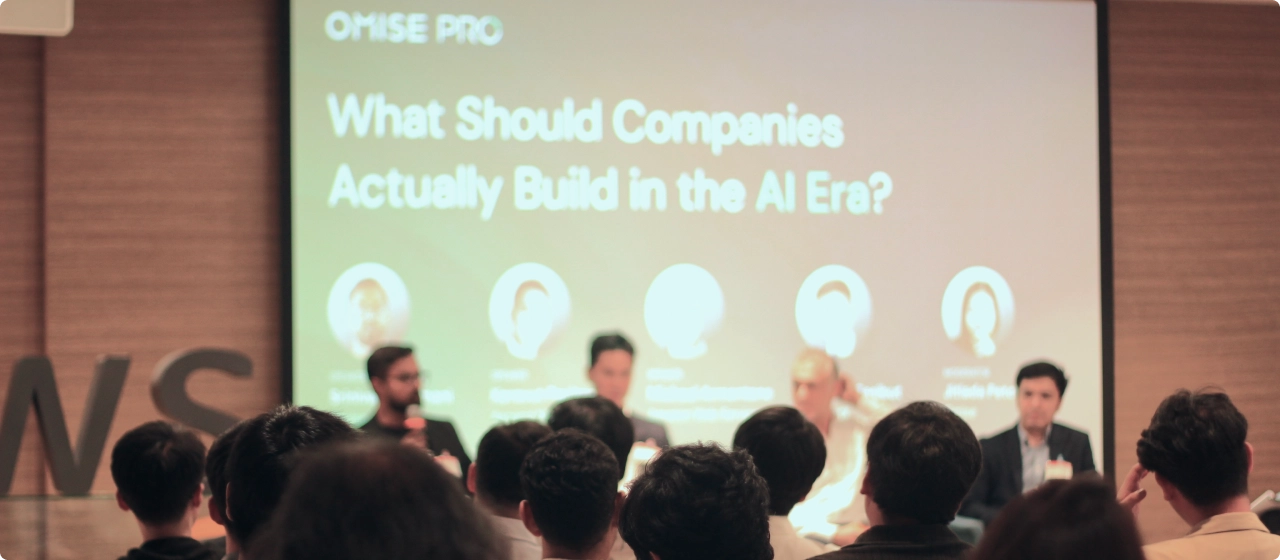
That question was at the heart of Build Forward #1: What Should Companies Actually Build in the AI Era?, the first event in Omise Pro’s new knowledge-sharing series.
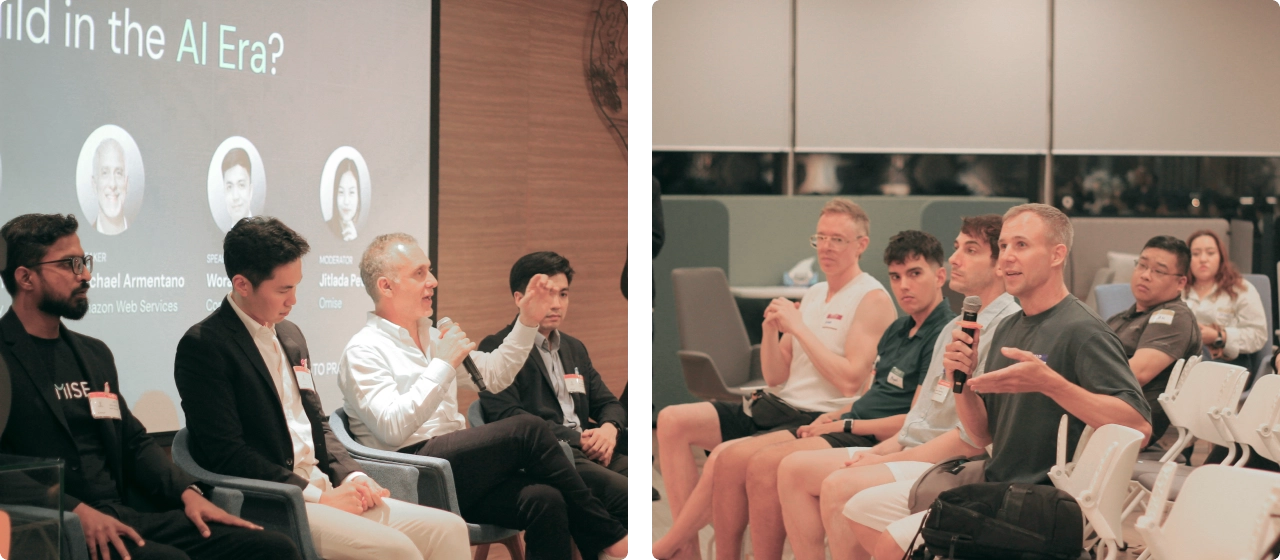
Hosted at AWS Thailand on the 3rd of July, the session brought together leaders from financial services, customer data platforms, cloud technology, and software engineering to discuss what AI adoption looks like beyond the hype.

The conversation covered a lot of ground, from measurable business value and production challenges to cost management, build-versus-buy decisions, and the changing role of people at work.
Here are some of the ideas that stood out.
A few years ago, many companies were still debating whether AI would become a meaningful business technology. Today, that debate is starting to feel outdated.
During the panel, AI was compared with earlier technology shifts such as the internet and cloud computing. Both were initially questioned before eventually becoming essential parts of modern business.
AI appears to be moving in the same direction.
Some financial organizations have already used machine learning for credit modeling and personalization for years. What has changed is how accessible the technology has become.
Today, people without deep engineering backgrounds can now use AI to generate code, analyze information, automate tasks, and turn ideas into working prototypes much faster than before.
But this does not mean companies should add AI to every workflow they can find. The more useful question is:
Where can AI create meaningful value, and where would it simply add more complexity?

When people talk about AI, the conversation often jumps to autonomous agents, intelligent assistants, and new business models.
But many of the biggest wins today are much more practical.
Ascend Money shared how a team of 14 people had been manually reading paper documents and extracting information. By introducing an AI-powered OCR workflow, the organization was able to automate much of the process, with an estimated saving of around 10,000 working hours.
The company also set a broader target of saving 150,000 employee hours within one year. Around 60,000 hours had already been saved during the first six months.

No futuristic robot. No complete reinvention of the business. Just a slow and repetitive workflow removed—and thousands of hours returned to the team.
This is where AI is already creating practical value: reviewing documents, extracting data, preparing reports, and reducing administrative work. The goal is not simply to automate people out of the process. It is to give them more time for work that requires judgment, creativity, and domain expertise.
AI is also changing what companies can do for their customers.
Personalized communication traditionally required coordination between data, marketing, content, and design teams. Producing different messages and creative formats could take days. Now, much of that work can happen within minutes.

The panel shared examples of AI being used to generate tens of thousands of message variations and resize a single creative asset into multiple formats within seconds. This allows businesses to move closer to individual-level personalization rather than communicating with customers only through broad segments.
But there is an important catch: AI is only as reliable as the information beneath it.
If customer data is duplicated, inconsistent, or scattered across different systems, adding AI will not fix the foundation. It may simply produce the wrong answer faster.
Before creating smarter customer experiences, companies still need to get the basics right.
One of the most honest moments of the discussion came from Omise’s engineering team. The team had built an AI product and was impressed by how quickly it reached the demonstration stage. It worked well, looked promising, and was moved into production. Within one or two weeks, user complaints began arriving.
The mistake was believing that the demo was already the product.
A demo proves that an idea can work under a specific set of conditions. A production system must work reliably across different users, inputs, and situations. That still requires testing, debugging, monitoring, security reviews, and human validation. AI may help a team reach the first version faster, but it does not remove the engineering work required to make that version dependable. Or, as the discussion revealed:
The visible cost is the model. The hidden cost is everything required to make it work in the real world.

As organizations rush to find AI use cases, there is a risk of making simple problems unnecessarily complicated.
A session panelist described reviewing dozens of workflows that had been proposed for AI. After looking more closely, the team found that many could be solved with a basic script, a better data pipeline, or traditional automation.
Not every repetitive task requires a language model.
And AI should not be used to cover up a broken process. Using AI to cover up a broken process often creates compounded inefficiency. Instead of solving the root issue, you build complexity on top of dysfunction—scaling errors, masking bottlenecks, and creating unnecessary technical debt.
Before choosing the technology, teams should first ask:
Sometimes AI will be the answer. Sometimes it will not—and that is still a good outcome.
Cost was another recurring theme throughout the session. When employees have access to several models, they may naturally choose the most powerful one—even when the task is simple. Across a large organization, those decisions can become expensive quickly.
The panel discussed using smaller, local, or open-source models for routine tasks while reserving more capable frontier models for complex work, which is similar to choosing a vehicle. A sports car can take you across the city, but it may not be the most efficient choice when you are sitting in traffic. The same is true for AI. Matching the model to the task is not only a technical decision. It is also a financial one.
Companies that want to scale AI sustainably need visibility into usage, clear cost controls, and an AI architecture that does not rely on the most expensive option for every request.
The answer from the panel was not simply one or the other.
Companies should generally buy capabilities that are already standardized and widely available. There is little value in rebuilding a generic coding assistant or common infrastructure tool from scratch.
But when a capability relies on proprietary data, supports a unique business process, or creates a genuine competitive advantage, building may make more sense.
A custom risk model or fraud-detection system, for example, may reflect knowledge and data that competitors cannot easily replicate.

Still, building comes with responsibility.
Models must be monitored and maintained. Customer behavior changes. Economic conditions change. A system that works today may become less accurate over time.
In many cases, the practical answer will be to combine both approaches: buy the platform, then build the differentiated workflow on top of it.
The goal is not to own every part of the technology.
It is to own the parts that make the business different.
Introducing new tools is only one part of AI transformation.
People also need to understand where and how to use them.
We were shared in the session about how it created a network of AI champions across 22 departments. These were people who understood both AI and the daily work of their own functions.
That combination mattered.
A central AI team may know the technology but may not understand every challenge faced by accounting, compliance, marketing, or operations. An AI champion can identify the right opportunity, explain the business context, and help turn an idea into a useful workflow.
The example showed that AI adoption is not only a technology challenge.
It is also a translation challenge.
The panel did not suggest that every company needs to adopt every new AI tool or build an agent for every department.
The message was more selective.
Companies need to identify problems worth solving, understand when simpler automation is enough, prepare their data, control costs, and keep human judgment involved where it matters.
AI is making it easier to create and experiment.
But deciding what to build, why it matters, and how to make it last remains the difficult part.
And that is exactly the conversation Build Forward was created to continue.
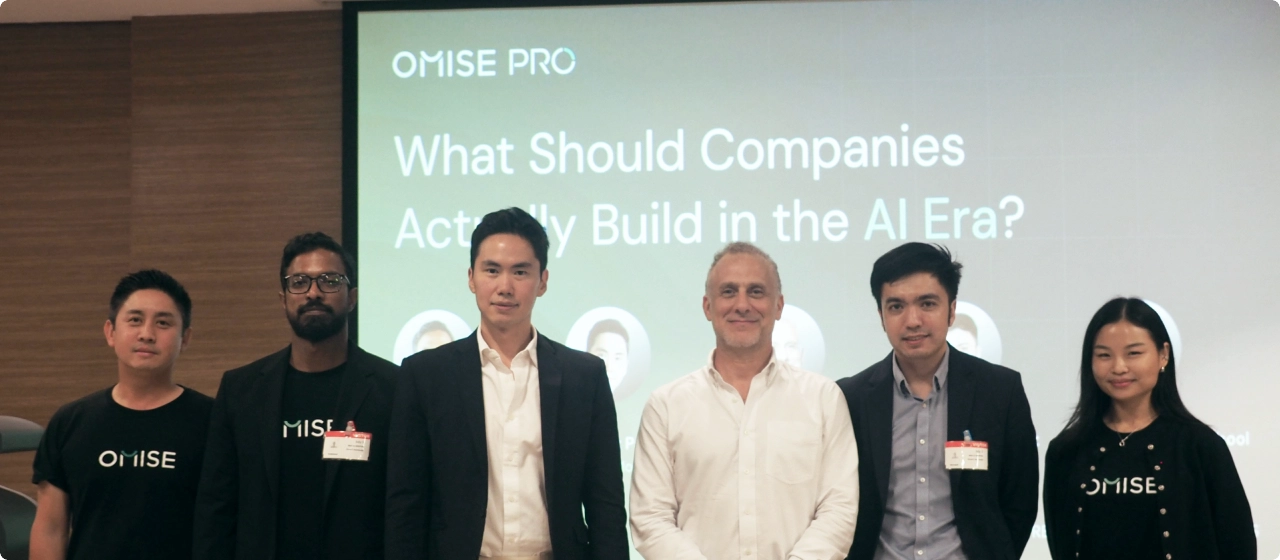
Thank you to our panelists, AWS Thailand, and everyone who joined us for the first edition of Build Forward.
This is only the beginning. We look forward to bringing together more technology leaders and industry practitioners to explore emerging technologies, share practical experiences, and discuss what organizations are actually building.
See you at the next Build Forward.


